Completion requirements
💡
Choose Your Learning Material
This the lesson is available in multiple formats The content is the same—feel free to choose the one way that fits your current learning environment. You do not need to complete all
VIDEO VERSION:
PODCAST VERSION:
SLIDE VERSION:
READING VERSION:
1. Introduction: Why the Development Model Matters
Black box testing focuses on what the system does (inputs  outputs), ignoring internal code structure. However, the software development lifecycle (SDLC) model dictates when you test, how you communicate, and what artifacts you create.
👉 Why this matters to you:
-
Timing: In Waterfall, you might wait months to test. In Agile, you test on Day 2 of a sprint.
-
Documentation: Waterfall requires detailed proof (Step-by-step Test Cases). Agile prizes speed and intuition (Checklists/Exploratory).
-
Job Role: A Waterfall tester is often a "gatekeeper." An Agile tester is a "collaborator."
2. The Waterfall Model
What is it?
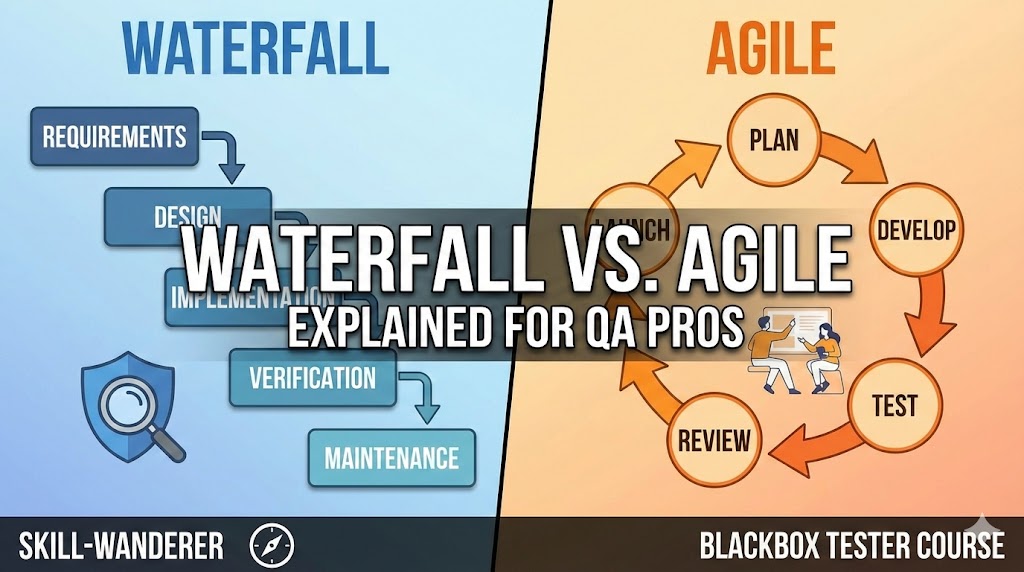
Waterfall is a linear, sequential approach. Imagine a real waterfall; water flows down and cannot easily flow back up. A phase must be 100% complete and "signed off" before the next one starts.
Typical Phases & The Tester's Role
-
Requirements: (Tester reviews requirements for testability).
-
Design: (Tester plans the strategy).
-
Implementation/Coding: (Tester writes detailed scripts).
-
Testing: (The "Testing Phase" officially begins here).
-
Deployment & Maintenance.
Waterfall from a Black Box Tester’s View
-
Source of Truth: The Requirements Document (BRD/SRS). If the software behaves differently than the document, it is a bug—even if the software is "better."
-
Artifacts: Heavy emphasis on formal Test Plans, Traceability Matrices (RTM), and detailed Test Cases with pre-conditions and post-conditions.
-
Bug Fixing: Bugs found here are expensive because the code was written weeks or months ago.
💡 Real-World Scenario: The Banking System
You are testing a core banking mainframe update.
-
Why Waterfall? Regulations require a paper trail for every change. Errors can cost millions or result in lawsuits.
-
Your Job: You spend 4 weeks writing test cases based on a 200-page specification document before you ever see the software.
Pros & Cons for Testers
|
Pros |
Cons |
|
Clear expectations (Expected Results are documented). |
Boring "waiting periods" during coding. |
|
Easy to track progress (RTM). |
"Crunch time" pressure: Development delays eat into Testing time. |
|
Stable requirements (scope creep is managed). |
If a requirement was misunderstood early on, you won't catch it until the very end. |
3. The Agile Model
What is it?
Agile is iterative and incremental. Instead of building the whole car at once, you build a skateboard, then a scooter, then a bike, then a car. Development happens in short cycles called Sprints (usually 2 weeks).
Key Concepts for Testers
-
User Stories: Requirements are small, user-focused sentences (e.g., "As a user, I want to reset my password so I can regain access").
-
Acceptance Criteria (AC): The specific conditions the Black Box tester must verify to pass the story.
-
Definition of Done (DoD): The checklist that proves a task is truly finished (e.g., "Code written, Tested, No critical bugs").
Agile from a Black Box Tester’s View
-
Source of Truth: The User Story and conversations with the Product Owner.
-
Artifacts: Lightweight. Mind maps, checklists, one-page test strategies, and automated regression scripts.
-
Timing: Testing happens concurrently with coding. You might test a feature on Tuesday that was coded on Monday.
💡 Real-World Scenario: The Social Media App
You are testing a new "Stories" feature for a startup.
-
Why Agile? Market trends change fast. They need to release something next week to beat a competitor.
-
Your Job: You don't have a heavy spec document. You talk to the designer and developer, agree on how it should work, and run exploratory tests immediately.
Pros & Cons for Testers
|
Pros |
Cons |
|
You find bugs immediately (cheaper to fix). |
Documentation is often scarce or outdated. |
|
You influence the design early. |
Regression testing burden is high (re-testing old features every 2 weeks). |
|
Constant collaboration (less loneliness). |
Requirements can change mid-sprint. |
4. High-Level Comparison Cheat Sheet
|
Feature |
Waterfall |
Agile |
|
Requirement Stability |
Fixed (Changes require Change Requests) |
Flexible (Changes welcomed) |
|
Testing Timing |
A distinct phase after coding |
Continuous, during coding |
|
Tester's Mindset |
"Verification" (Does it match the spec?) |
"Validation" (Is it useful to the user?) |
|
Documentation |
Heavy, formal, approved |
Lightweight, "Just enough" |
|
Team Structure |
Silos (Testers sit with Testers) |
Cross-functional (Testers sit with Devs) |
|
Feedback Loop |
Long (Months) |
Short (Daily/Weekly) |
5. Impact on Black Box Techniques
The actual techniques (Equivalence Partitioning, Boundary Value, etc.) don't change, but how you apply them does.
In Waterfall: "The Formal Approach"
-
Technique: Decision Table Testing.
-
Application: You create a complex table mapping every possible input combination from the Specification Document.
-
Technique: Boundary Value Analysis.
-
Application: You formally document test cases for min, min-1, max, max+1 based on the Requirements Spec.
-
Traceability: You must link every Test Case ID to a Requirement ID.
In Agile: "The Rapid Approach"
-
Technique: Exploratory Testing.
-
Application: You use your domain knowledge to "hunt" for bugs without a script, focusing on new features.
-
Technique: Acceptance Test-Driven Development (ATDD).
-
Application: You write the test cases (often in Gherkin syntax: Given/When/Then) before the code is written to guide the developer.
-
Regression: Heavy reliance on Automation because manual testers cannot re-test the whole system every 2 weeks.
6. Summary for Learners
-
Waterfall is about predictability and control. It is document-driven. Testers act as quality gatekeepers at the end.
-
Agile is about adaptability and speed. It is conversation-driven. Testers act as quality coaches throughout the process.
🧠 Critical Thinking Note:
Most modern companies claim to be "Agile," but many practice "Water-Scrum-Fall" (Agile meetings, but Waterfall requirements and deadlines). A good Black Box tester learns to adapt to the reality of their specific team, regardless of the label.
7. Exam & Interview Prep
Be ready to answer these common questions:
-
"How does your test strategy change if we switch from Waterfall to Agile?"
-
Answer: "I would shift from writing heavy documentation upfront to focusing on exploratory testing and automation. I would collaborate with developers earlier rather than waiting for a build."
-
"Can you use Boundary Value Analysis in Agile?"
-
Answer: "Absolutely. The technique is the same, but instead of documenting it in a 50-step test case, I might just add it to the Acceptance Criteria or a quick test checklist."
-
"Which model is better?"
Answer: "Neither is strictly better; it depends on the project. Waterfall is better for safety-critical, stable projects (like medical devices). Agile is better for consumer-facing apps where requirements change often."
Last modified: Monday, 2 February 2026, 7:32 AM